
The first winter leak usually shows up at the worst possible moment. A drip hitting the kitchen counter during Sunday breakfast. A brown ring on the bedroom ceiling that wasn’t there yesterday. A puddle on the hardwood below a window with no obvious source. If you need help troubleshooting a winter roof leak after a freeze, the next hour matters more than the following week. Contain the water, document what you see, stay off the roof, and involve a roofer the same day.
Key Takeaways
|
The First Hour: What to Do the Moment You See Water Coming In
The first hour of a winter leak matters more than the next few days. The right moves early keep the damage small and give the roofer something to work with when they arrive.
Contain the Drip and Protect What’s Underneath
Get a bucket, pot, or trash can under the drip right away. Towels around the base catch splatter. Move furniture, electronics, laptops, rugs, and anything else of value out of the drip zone. If the leak is spreading across a larger area, lay down plastic sheeting or a shower curtain to catch runoff. Don’t try to patch the ceiling yet. Containment first, repair later.
Relieve a Bulging Ceiling Before It Collapses
A ceiling sagging under trapped water is a serious collapse risk. The counterintuitive move is to make it worse before it gets better. Take a screwdriver or small knife and poke a controlled hole at the lowest point of the bulge, with a bucket directly underneath. Letting the water out through one controlled point prevents a much larger section of drywall from giving way and dumping a ceiling’s worth of water onto the floor.
Document Everything With Photos, Video, and Timestamps
Before you clean anything up, take photos and video from every angle. Wide shots of the room, close-ups of the stain, video of the active drip, timestamps visible if possible. If water is coming through a light fixture or around a vent, capture that too. Your future insurance claim depends on evidence from the first few minutes, not after you’ve mopped the floor and dried everything out.
Call a Roofer the Same Day, Not Tomorrow
Winter leaks don’t pause between freezes. Every thaw cycle pushes more water through the same path, and the damage compounds quickly. Same-day calls get temporary stabilization in place before the next storm. A good roofer with a 24/7 emergency line will walk you through what to do over the phone, even if they can’t be on site for a few hours.
Why Roofs Leak After a Freeze: The Five Likely Causes
A winter leak is almost never random. It’s usually one of a short list of causes, and figuring out which one shapes the fix.
Ice Dams
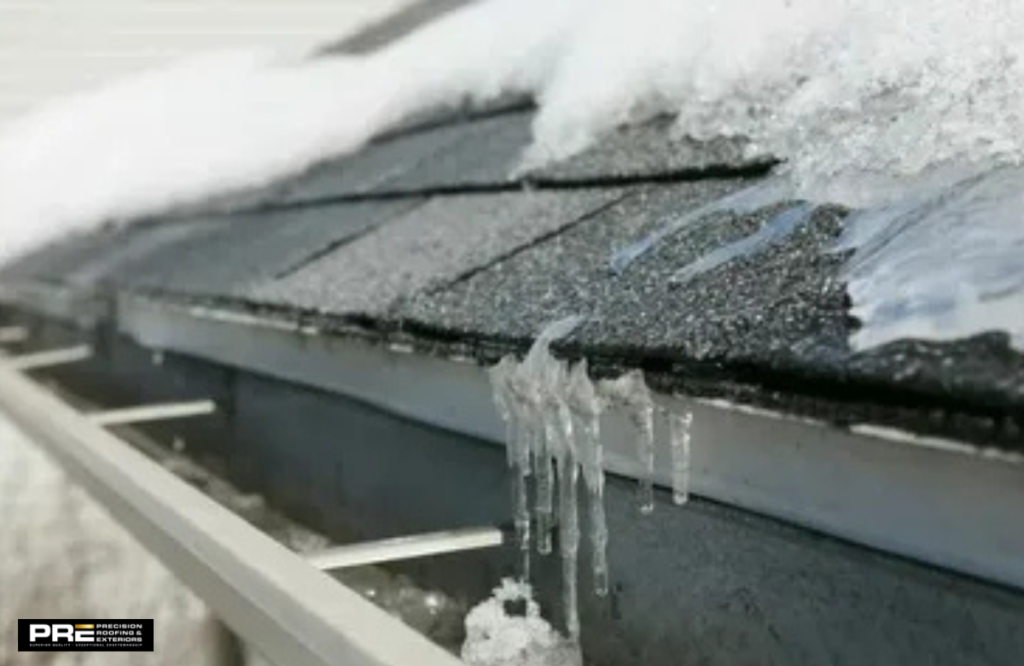
Ice dams are the most common winter leak cause by a wide margin. They form when warm air escapes through a poorly insulated attic, melting the snow on the middle of the roof. The meltwater runs down the slope, hits the colder eave, and refreezes into a ridge of ice. Fresh meltwater then backs up behind that ridge and pushes under the shingles, into the roof deck, and eventually into the house. The classic leak pattern shows up near the exterior walls at the top of the wall or near the ceiling perimeter.
Flashing That Fails When Water Pools Instead of Running Off
Chimneys, vents, skylights, valleys, and roof-to-wall intersections all depend on flashing to keep water out. In warmer months, water flows past these joints without a problem. In winter, snow and ice park on them and find every weak point. A flashing leak often shows up around the same spot every winter and may dry up completely in summer.
Attic Condensation That Looks Like a Roof Leak
Not every winter leak is actually a leak. Warm, humid indoor air rising into a cold attic can condense on the underside of the roof deck, then drip down onto the ceiling below. The pattern is usually widespread small drops rather than a single stream. If you crawl into the attic and see frost on the underside of the roof deck, condensation is the real problem and the fix is better ventilation and air sealing, not roof repair.
Cracked Vent Pipe Boots and Skylight Seals
Rubber vent pipe boots become brittle after years of UV exposure and freeze-thaw cycles. A hairline crack that’s invisible in July opens up when ice expands inside it in January. Skylight seals follow the same pattern. These leaks are usually localized, directly beneath the penetration, and often small but persistent.
Frozen or Torn-Off Gutters Driving Water the Wrong Direction
Gutters full of ice can’t move meltwater. The water finds the next lowest path, which is often back under the shingles at the eave or down the fascia and into the wall below. A gutter that got torn off completely during a storm, or one that’s bent out of alignment, does the same thing. If your leak traces to the roof edge and your gutters look full of ice or damaged, that’s your likely answer.
How to Tell Which Winter Leak You’re Actually Dealing With
The leak’s location and behavior narrow the cause faster than guessing. The patterns below cover the four most common winter leak types you’re likely to see.
Signs It’s Probably an Ice Dam
- Visible icicles or a ridge of ice at the eave.
- Leak staining within a few feet of the exterior wall at the top of the wall or near the ceiling perimeter.
- Leak only shows up during or just after a thaw.
- Fresh insulation or drywall damage along the outside walls upstairs.
Signs It’s Probably a Flashing Failure
- Leak traces back to a chimney, skylight, vent, or roof valley.
- Water shows up slowly and persistently rather than during obvious thaw events.
- The same spot has leaked before, maybe even in heavy summer rains.
- Discoloration or staining around a specific penetration.
Signs It’s Attic Condensation, Not a Leak
- Widespread small drops across a cold ceiling area, not a single stream.
- Frost on the underside of the roof deck, visible from the attic.
- Humidity feels high inside the house.
- Shows up during the coldest stretches, not during thaws.
Signs It’s a Burst or Frozen Pipe, Not the Roof
- Leak traces to a wall or ceiling directly below a bathroom, kitchen, or exterior pipe run.
- Water smells of plumbing or has a chlorine edge.
- Flow doesn’t change with outside temperature the way a roof leak does.
- Suddenly stops when you shut off the house water supply.
Safe Temporary Fixes You Can Try From the Ground
A few things are safe to do yourself without climbing anything. Each one buys time until a professional can get on site, and none of them count as a real fix.
Pull Snow Off the Lower Roof With a Snow Rake
A telescoping snow rake pulls snow off the first 3 to 6 feet of roof from the ground. Clearing the eave removes the material that feeds an ice dam, often slowing the leak within hours. Work in sections, pull toward yourself, and keep your eyes up for falling snow or ice. Never use metal tools that could scrape or damage the shingles.
Place an Ice Melt Sock Across the Dam
Fill a leg of pantyhose or a mesh sock with calcium chloride ice melt (not rock salt, which damages shingles). Lay it perpendicular across the ice dam. The sock melts a channel through the ice over several hours, letting water drain instead of backing up. It’s a temporary move to buy time, not a permanent fix.
Clear Gutters If You Can Safely Reach Them
Only from a stable ladder with a spotter, on a dry day, with no ice present. If any of those conditions aren’t met, skip it and let the roofer handle it. Gutters full of frozen debris are a two-person job and a bad time to find out your ladder isn’t rated for ice.
What Not to Do When Your Roof Is Leaking in Winter
The actions below make winter leaks worse, and a couple of them put homeowners in the hospital. Avoid all of them, no matter how tempting the shortcut looks.
Don’t Chip Ice Off the Roof With a Hammer, Shovel, or Pick
Chipping cracks the shingles underneath, punctures the roof deck, and turns a water leak into a repair that costs ten times as much. Professionals use low-pressure steam, which melts ice without touching the roof surface. Never use force.
Don’t Throw Rock Salt Directly on Shingles
Sodium chloride stains asphalt shingles, corrodes metal flashing, kills whatever landscaping sits below, and does almost nothing for the ice above. Calcium chloride in a sock is the only acceptable form of ice melt on a residential roof.
Don’t Climb an Icy Roof, Ever
Snow-covered pitched roofs are the number-one source of winter fall deaths and serious injuries among homeowners. No DIY repair is worth it. A professional with safety equipment can be on your roof in a few hours. Wait.
Don’t Wait and See
The second cold snap is almost always worse than the first. Every refreeze adds pressure to the leak path, and small leaks become big ones faster than you’d expect. “Let’s see if it keeps dripping” is the move that turns a $500 repair into a $5,000 ceiling replacement.
Conclusion
Winter roof leaks are a race against the next freeze, and the early moves matter more than any single repair later. Contain the water, document the damage, keep yourself off the roof, and bring a professional in before the next storm.
If water is showing up on your ceiling right now, the team at Precision Roofing & Exteriors offers same-day emergency winter roof service and can stabilize the leak before the next cold snap makes it worse. If the leak is slow and you have time to plan ahead, our roofers can walk your roof, flashing, insulation, and ventilation to find the weak spots before winter weather turns a small problem into a major repair. Reach out through our website to get the right help scheduled.