
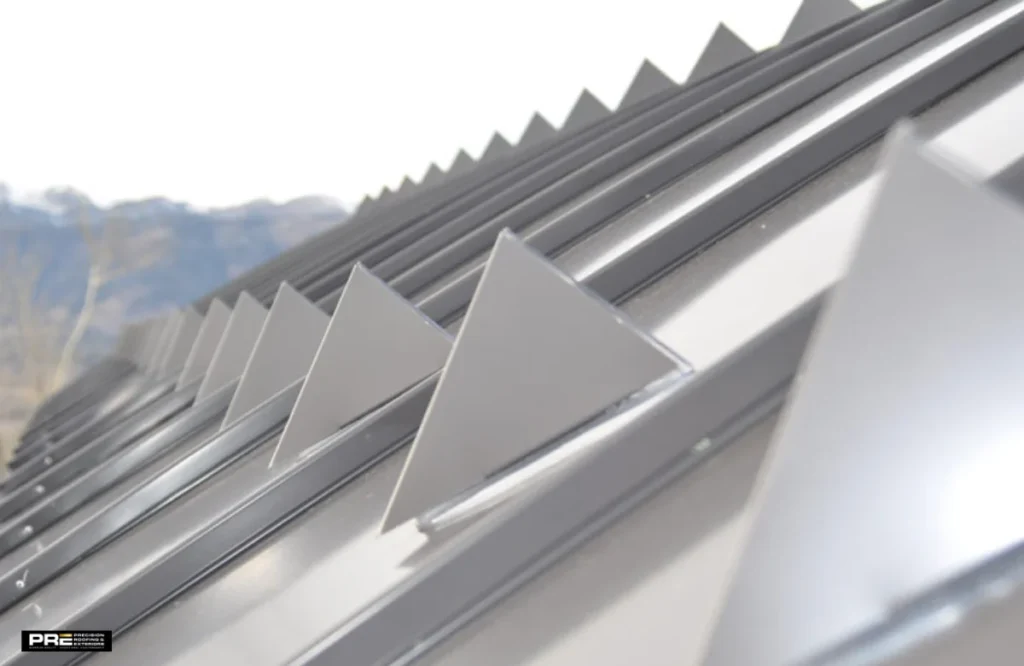
A sunny February afternoon after a quiet overnight snow. The parking lot looks clear; you walk out to grab the mail, and a sheet of frozen snow slides off the metal roof onto your car’s hood. That is the moment most Tri-Cities homeowners start asking about snow guards.
Not every metal roof here needs them, but a lot do. Snow guards for metal roofs can help prevent heavy snow and ice from sliding off the roof all at once. Knowing whether your house needs them saves money and prevents real damage. The decision comes down to three things: how much snow your part of the Tri-Cities actually gets, how steep your roof is, and what sits directly below the eaves.
Key Takeaways
|
When a Tri-Cities Metal Roof Actually Needs Snow Guards
A metal roof in the Tri-Cities needs snow guards when three factors line up. Any one of them alone usually isn’t enough reason. Two or three together usually is.
The Three Factors That Decide: Snowfall, Pitch, and What’s Below
Snowfall is the first factor. The Tri-Cities region averages around 15 to 20 inches a year, with heavier events in the higher elevations around Mountain City and Elizabethton. That’s enough snow accumulation to produce sliding slabs on the wrong roof.
Pitch is the second factor. Metal roofs above about 4:12 shed snow faster and more suddenly than lower-pitched roofs. Steeper roofs produce bigger slides.
What sits below the eaves is the third factor, and often the deciding one. People, pets, cars, HVAC condensers, propane tanks, decks, lower roof sections. Each of these turns a snow slide from an inconvenience into damage or an injury claim.
Clear Cases Where Snow Guards Are Worth the Money
Snow guards pay for themselves in several common situations around the Tri-Cities:
- A metal roof directly over the main entrance, walkway, or front door
- A steep roof above an attached deck, patio, or outdoor seating area
- A lower roof section that catches snow sliding off an upper roof
- HVAC equipment, generators, or propane tanks located under the eave
- A metal roof over a driveway where cars are regularly parked
If your house checks any of these boxes, the question isn’t whether to install snow guards. It’s where and what kind.
Situations Where You Can Safely Skip Them
Not every metal roof needs snow retention. You can usually skip snow guards when the pitch is low (under about 3:12) and the roof tends to hold snow rather than shed it, when the eaves face an empty backyard or landscaping that can handle snowfall, when the roof is in a sheltered or lower-elevation area that sees relatively little accumulation, or when the overhang is short with nothing significant underneath. Full-roof coverage on a house like that is money spent protecting nothing in particular.
Why Metal Roofs Shed Snow Differently Than Shingle Roofs
Understanding why metal roofs behave the way they do under snow helps the whole decision make more sense. It’s quieter, slicker, and more sudden than a shingle roof, and that’s by design.
The Slick-Surface and Compressed-Slab Problem
Painted metal is intentionally smooth so water sheds instead of sitting on the surface. Snow doesn’t bond to it the way it bonds to asphalt. On a sunny day, the sun warms the metal from below the snow layer, melting the thin band right against the roof. The snow above that melted layer is now a compressed slab sitting on a sheet of water, and the whole thing slides at once. Shingle roofs don’t do this. Their rough surface and granular texture grip the snow, letting it release gradually in smaller amounts.
What a Full-Roof Snow Slide Can Actually Damage
A snow slide off a two-story metal roof is heavier and faster than most homeowners expect. The damage list is long: gutters torn off the fascia, cars dented, windshields cracked, HVAC fins bent, deck furniture crushed, propane tank connections sheared. Insurance claims after a bad Tri-Cities snow event often include at least one of these. Serious injuries happen less often but they do happen, especially to anyone standing under the eave when the slab lets go.
How Tri-Cities Snow and Ice Storms Compare?
The Tri-Cities doesn’t see Northeast-level snowfall, but it does see enough winter weather for sliding snow to matter. Average annual snowfall for Johnson City, Kingsport, and Bristol runs around 15 to 20 inches, with occasional heavier mountain events to the east.
The region’s bigger winter risk is often ice. Freezing rain adds weight to whatever snow is already sitting on the roof and creates slick layers that release unpredictably when temperatures swing. Elevation matters too. Higher elevations around Elizabethton, Mountain City, and the Blue Ridge foothills see more accumulation than downtown Johnson City or Kingsport.
The Types of Snow Retention Systems for Metal Roofs
Not every snow guard works on every roof. Four main categories cover almost all residential installations, each with a different fit depending on panel type, pitch, and snow load.
Pad-Style (Individual) Snow Guards
Pad-style guards are small triangular or pyramid-shaped pieces mounted individually across the roof, usually in a staggered pattern. They’re the lowest-cost option and work well for light to moderate snow loads. Common on exposed-fastener panels. Spacing is critical: too few and snow slides between them, defeating the whole purpose.
Pipe- and Rail-Style Systems
Pipe and rail systems use continuous horizontal bars that run along the eave. They hold significantly more snow than individual pads and are the standard for heavier snow loads and steeper pitches. More visually prominent than pad guards, but much better at stopping a real slide. On standing-seam roofs, these systems clamp onto the seams without penetrating the panels.
Fence-Style Snow Retention
Fence-style systems are essentially a short fence running along the roofline. They offer the highest holding capacity and are used in heavy-snow mountain areas and commercial applications. Overkill for most Tri-Cities homes, but worth considering on a steep roof in a higher-elevation property that regularly sees big accumulations.
Clamp-On vs. Through-Panel Mounting
The attachment method matters as much as the guard type. On standing-seam metal, clamp-on hardware (S-5! clamps are the industry standard) attaches without penetrating the panel. On exposed-fastener panels (R-panel, corrugated), snow guards are usually mechanically fastened through the panel into the deck with sealed screws.
Using the wrong method for your panel type is one of the most common installation mistakes, and it’s where leaks and voided warranties come from.
Where Snow Guards Should Actually Go on Your Metal Roof
Full-roof coverage sounds safe, but it’s usually unnecessary and expensive. Selective placement is almost always the smarter move.
Above Entrances, Front Doors, and Walkways
This is the non-negotiable spot. Nobody should open the front door into a sliding snow slab. If your metal roof covers the main entrance, side door, or any walkway people regularly use, this is where snow guards earn their place first. Even a short run of guards above the entry solves the biggest safety problem for a fraction of the cost of full coverage.
Over Driveways, Decks, HVAC Units, and Propane Tanks
Vehicles and equipment catch the worst of a slide. Snow guards above these areas protect expensive assets that can’t be moved. On most Tri-Cities homes, the HVAC condenser sits a few feet off the back of the house, often directly under a lower roof eave. A short section of guards above it is cheap insurance.
At Lower-Roof Transitions
When an upper roof dumps snow onto a lower roof section (common in two-story Tri-Cities homes with attached garages or additions), the lower roof almost always needs protection.
The snow sliding off the upper roof hits the lower roof at speed, can tear through soft-metal flashing, and sometimes causes structural issues over time. Guards on the upper roof above the transition prevent all of this.
Where Snow Guards Usually Don’t Belong
Over empty backyards. Over landscaping that can handle snow falling on it. Over sections of roof where the eaves face an unused area. Covering the whole roof when only half of it faces anything worth protecting is wasted money, and extra guards don’t make a protected area any safer than enough well-placed ones.
A professional walking the roof usually identifies two or three priority zones and recommends targeted installation rather than wall-to-wall coverage.
Conclusion
Metal roofs in the Tri-Cities don’t all need snow guards, but a lot of them do. Start by looking at what’s under your eaves. If it’s a front door, a driveway with cars, an HVAC unit, a deck, or a lower roof, snow guards belong there. If it’s an empty backyard, you probably don’t need them.
The right system depends on your panel type and pitch, and the wrong installation can void your roof warranty, so this isn’t a weekend DIY project. If you’re not sure whether your metal roof needs snow guards or you want a selective install done the right way, the team at Precision Roofing & Exteriors can walk your roof, assess the risk zones, and recommend the system that fits your home.