
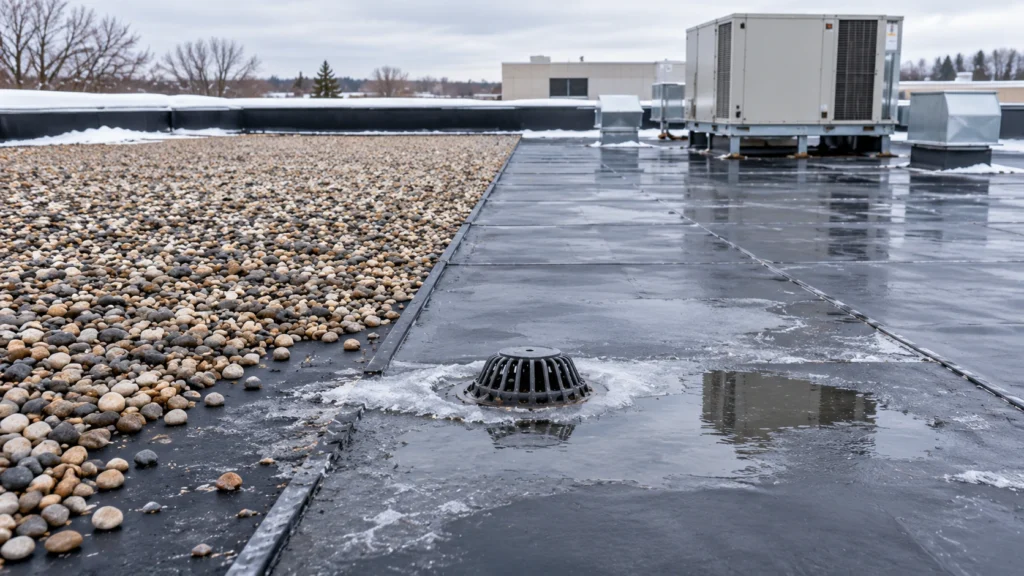
Standing water on a flat roof is bad enough in summer. In winter it freezes, thaws and refreezes, working at seams and flashing for weeks. For roofs that experience winter ponding, fully adhered EPDM offers advantages in inspection access and limiting membrane movement. However, both systems can withstand standing water when properly designed and installed.
The membrane stays bonded in place, leaks stay closer to their source and inspectors can see the surface. Ballasted systems still work well on strong decks with good drainage. The right choice between ballasted and fully adhered EPDM depends on how your commercial flat roof handles water, wind and weight.
Key Takeaways
- Fully adhered EPDM offers advantages in inspection access and limiting water migration beneath the membrane. Both systems can withstand standing water when properly designed and installed.
- Ballasted EPDM systems commonly use at least 10 pounds of stone ballast per square foot, although actual requirements depend on the roofing assembly and wind-design specifications.
- Freeze-thaw cycles, ice weight and winter wind affect both systems, though leaks are much harder to trace under ballast and ice can freeze loose stones against the membrane.
- Neither system fixes poor drainage. Slope, clear drains and regular inspections matter more than the attachment method in the long run.
Ballasted vs. Fully Adhered EPDM: Understanding the Differences
Both systems use the same rubber membrane. The difference lies in how that membrane stays in place which affects weight, inspection and the way each roof reacts to water.
How Ballasted EPDM Roofing Is Installed
A ballasted EPDM roof is laid loose over the insulation, with no adhesive or fasteners in the field of the roof. Only the edges and penetrations are secured. River stone or concrete pavers then cover the whole surface.
According to Professional Roofing magazine, these systems use a minimum of 10 pounds of ballast per square foot and can add 10 to 25 pounds per square foot to a building’s load. Installation is fast, though the deck must be strong enough to carry that weight.
How Fully Adhered EPDM Roofing Is Installed
In a fully adhered system, the membrane is bonded to a cover board or insulation with adhesive across the entire surface. Crews apply bonding adhesive to both the membrane and the substrate, let it flash off, then press the sheet into place. The finished roof is lightweight and exposed which leaves the membrane open to sunlight and foot traffic but easy to inspect.
Membranes commonly come in 45-, 60- and 90-mil thicknesses, with thicker sheets offering more puncture resistance. Adhesive work also depends on weather, since many products need dry surfaces and temperatures above a minimum set by the manufacturer.
Key Differences in Membrane Attachment, Weight, and Maintenance
A ballasted membrane floats on the insulation and depends on gravity to stay down. A bonded membrane can’t shift once the adhesive cures. Weight follows from that choice.
A ballasted roof weighs many times more per square foot than an adhered one which limits the buildings it suits. Maintenance differs as well. Stones and pavers have to be moved before anyone can inspect or repair the membrane underneath.
An adhered roof can be walked and checked in a single pass. Cost also plays a role, since ballasted systems often install faster with fewer materials in the field.
Ballasted vs. Fully Adhered EPDM: Which Performs Better Under Winter Ponding?
Winter ponding tests a roof in several ways at once. Five factors show where each EPDM system holds up and where it tends to fall behind.
Resistance to Prolonged Water Exposure
EPDM rubber tolerates standing water well. The bigger risk sits at seams, flashings and penetrations, where water that lingers for weeks can find a weak spot. The National Roofing Contractors Association (NRCA) defines ponding as water that remains more than 48 hours after precipitation under conditions that allow drying.
On a ballasted roof, stone can obscure ponding areas and make it harder to identify drainage problems during visual inspections. A fully adhered roof shows ponding right away which makes it easier to correct with added drains or tapered insulation.
Performance During Freeze-Thaw Cycles
Repeated freeze-thaw cycles can worsen existing weaknesses around seams, flashing and penetrations, particularly when water enters existing defects. Ballast adds another problem. Shifting ballast can expose sections of the membrane or increase the risk of abrasion if the stones become displaced.
Adhered roofs avoid that issue, though their weak point is the bond itself. If water gets under the membrane through a damaged seam, repeated freezing can push the sheet away from the substrate and leave blisters behind.
Membrane Movement and Thermal Expansion
EPDM stays flexible in cold weather, though it still expands and contracts as temperatures swing. A loose-laid ballasted membrane can move without stressing the field of the roof.
Adhered membranes move with the substrate instead which concentrates stress at seams, edges and penetrations. Proper perimeter securement and well-built flashing details handle that movement on most adhered roofs. Cold also slows adhesive curing which is why many crews avoid adhered installations in freezing weather.
Wind Uplift Resistance During Winter Storms
Winter storms bring strong wind, especially at roof edges and corners. Ballasted systems are designed under ANSI/SPRI RP-4, a wind standard developed by SPRI, an association of single-ply membrane and component suppliers, and approved by the American National Standards Institute (ANSI).
Starting with the 2021 International Building Code (IBC), RP-4 became the sole reference for designing ballasted single-ply roofs. Heavier ballast or pavers at edges and corners improve resistance. Loose stones blown off an edge can also damage nearby equipment or windows. Fully adhered roofs resist wind uplift through their bonded attachment, making them suitable for some buildings where loose ballast may be impractical. The selected assembly must still meet applicable wind-uplift requirements.
Leak Detection and Repair Accessibility
Finding a leak under ballast is slow work. Stones or pavers have to be cleared in small sections before anyone can see the membrane. Water can also travel under a loose sheet before it shows up inside, sometimes far from the actual hole.
A fully adhered membrane limits that travel which keeps leaks closer to their source. Repairs move faster too, since the crew can reach the damaged area without shifting ballast first.
Winter Maintenance Challenges for Different EPDM Systems
Snow and ice make both roofs harder to maintain. Ballasted roofs hide damage under stone and ice which often means waiting for a thaw before a full inspection. Shoveling carries risk on both systems, since metal tools and ice chippers can cut EPDM. Adhered roofs show damage more clearly.
Their exposed surface, however, takes the full impact of foot traffic and falling ice. On either roof, the most useful winter tasks are the same: keeping drains and scuppers clear, checking for ponding after each thaw and watching the structural load when snow and ice pile up in low areas.
Which EPDM Installation Method Is Better for Your Commercial Roof?
For most commercial roofs that see winter ponding, fully adhered EPDM is the safer choice. It keeps water from spreading under the membrane, makes leaks easier to find and works on taller buildings and more complex layouts.
Ballasted EPDM still makes sense on low, structurally strong buildings with simple roof shapes and good drainage, where its lower installed cost and built-in membrane protection pay off.
The deck’s load capacity, building height, wind exposure and drainage should guide the final decision. A roof with chronic ponding needs drainage fixes first, whichever attachment method it uses.
Conclusion
Fully adhered EPDM usually handles winter ponding better than ballasted EPDM. A bonded membrane limits how far water can travel, makes ponding visible and lets crews reach leaks quickly.
Ballasted systems protect the membrane and move freely with temperature changes, though they hide problems and add weight to the deck. Either system lasts longer with positive drainage, clear drains and inspections after each major thaw. Low, sturdy buildings with simple layouts can still get good service from ballast.
Our team at Precision Roofing & Exteriors can inspect your EPDM roof this winter and recommend the right fix for any ponding we find.
Pingback: If Your Commercial Roof Holds Water After Snowmelt, Here's What to Do Next - Precision Roofing & Exteriors