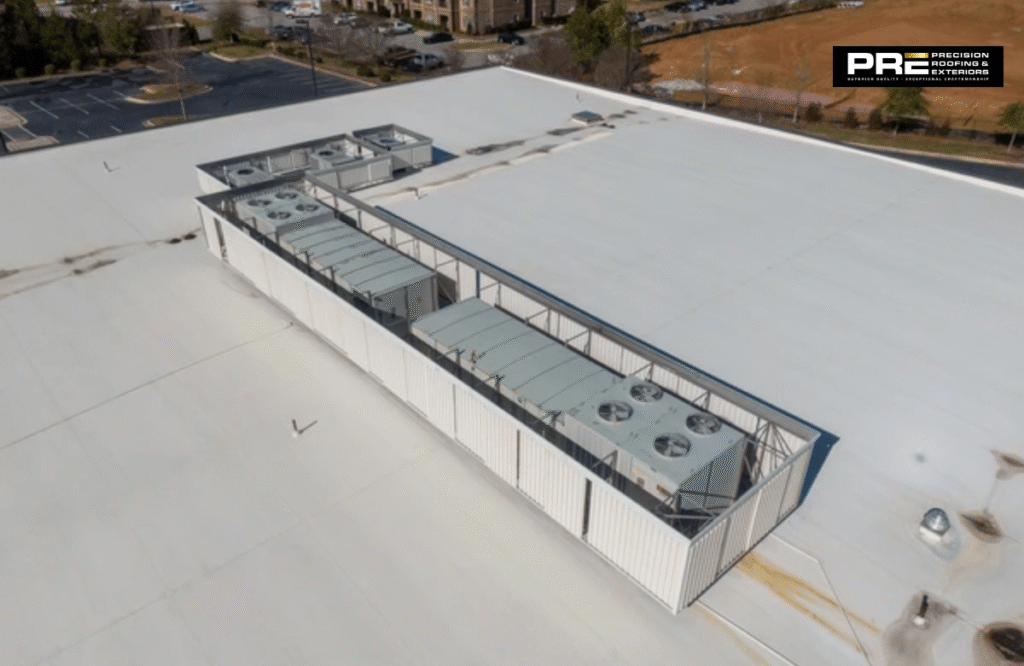
TPO roofing is a single-ply membrane used on flat and low-slope roofs. It’s made from thermoplastic polyolefin, a blend that delivers strength, flexibility, and heat-weldable seams. Installers roll out sheets, align overlaps, and fuse them with hot air to form a continuous, watertight layer. Because it reflects sunlight and resists many chemicals, it’s common in offices, warehouses, schools, and retail buildings.
If you’re weighing TPO roofing materials, think about climate, roof shape, traffic, and budget. TPO performs well when seams are welded correctly, and the insulation package is planned for your weather. It can be installed in several formats, from lightweight systems that go down fast to heavier builds that handle foot traffic and hail.
Understanding TPO Roofing
TPO is a white or light-colored sheet with a polyester or fiberglass reinforcement scrim in the middle. Sheets come in common widths like 10 or 12 feet and typical thicknesses such as 45, 60, or 80 mils. Seams are hot-air welded, not glued, which creates strong joints. The membrane can be attached with screws and plates, bonded with adhesives, or held in place with ballast, depending on wind and design needs. Good performance depends on proper substrate prep, clean welding, and correct flashing at edges and penetrations.
Types of TPO Roofing
Below are some of the common types of TPO roofing:
Standard TPO
Standard TPO is a smooth, reinforced sheet without extra fleece or factory adhesive. It’s a versatile base option that works with mechanical fastening or full adhesion. Contractors choose this when they want a light system and a quick install, especially on large, open roofs.
Reinforced TPO
Most commercial TPO is reinforced with a scrim that boosts tear strength and limits expansion and contraction. Reinforced sheets handle rooftop movement better and resist punctures from light foot traffic or dropped tools. They’re a good fit for roofs with more equipment or frequent service visits.
Fleece-Back TPO
Fleece-back adds a cushioned backing to the membrane. The fleece improves adhesion over rough surfaces and adds impact resistance over cover boards. It’s useful in recovery projects where the old roof stays in place, or where an extra cushion helps with hail or occasional foot traffic.
Self-Adhered TPO
Self-adhered sheets have an adhesive applied by the factory on the bottom side, which is then covered by a release liner. The installers simply peel off the liner and stick it, then heat-weld the seams as they normally do. This technique accelerates work, minimizes odor, and is more advantageous in delicate environments such as schools or hospitals. The condition of the substrate is still very important; the surfaces must be free of any dirt, moisture, and within the appropriate temperature range.
Mechanically Attached TPO
Mechanically attached systems use fasteners and plates along sheet edges or in the field, then weld laps to cover the hardware. They’re light, quick to install, and perform well in many climates. Because wind can create billows between fastener rows, detailing and fastener patterns must follow the wind design for the building’s exposure.
Fully Adhered TPO
Fully adhered systems use bonding adhesive to secure the entire sheet to the insulation or cover board. They’re smooth, quiet in the wind, and add uplift resistance across the whole surface. Adhesion takes more time and careful weather planning, but it delivers a clean look and reduces flutter, which helps at roof edges and around parapets.
Ballasted TPO
Ballasted systems lay the membrane loosely and hold it with smooth stone or pavers. They install fast on large roofs with enough structural capacity. Stone shields the sheet from UV and some impact, but it adds weight and makes leak tracing harder. Ballast also isn’t ideal where wind-borne debris is common.
Average Lifespan of TPO Roofing
If a TPO roof is designed and installed correctly, it can last on average 20 to 30 years. A thicker sheet, a perfect seam, and an excellent drain will surely prolong the life of a roof. It is always better to be preventive when it comes to roofing; hence, regular inspections, especially after heavy rain, can help find punctures or lifting flashing early. In hot sunny climates, reflective surfaces protect from heat stress, while in colder places, correct insulation and vapor control keep condensation risks that shorten service life at bay.
Benefits of TPO Roofing
Here are some of the most useful advantages of TPO roofing:
- Energy Efficiency: Light-colored TPO reflects sunlight and emits heat, helping lower cooling loads. Pairing it with the right insulation R-value gives steady indoor temperatures.
- Cost Savings: Material and labor costs are competitive, and large sheets mean fewer seams. Savings also come from shorter install times and reduced cooling energy in many climates.
- Durability: Reinforced TPO resists tears and punctures better than many older membranes. Properly welded seams are strong and handle thermal movement well.
- Flexibility: The sheets can be conformed to corner shapes as well as penetrations easily, and the system is applicable to many types of decks. The application potential is further increased with fleece-back or self-adhered options.
- Heat-Welded Seams: The bonding process of hot air welding is such that there are no solvents used, and therefore, the bonds have high tolerance. Even after many years, the welds still require heating and light-based inspection when necessary.
- Low Maintenance: A surface in good condition can be achieved through regular inspections, removal of debris, and prompt repairs. Cleaning helps in the retention of reflectivity and the early detection of minor problems.
Conclusion
TPO is a practical, modern membrane for low-slope roofs. It combines reflective surfaces, strong welded seams, and multiple attachment choices to match many building needs. Standard and reinforced sheets cover most jobs, while fleece-back and self-adhered versions solve specific site conditions. Whether you choose mechanical attachment, full adhesion, or ballast, the long life of TPO roofing depends on sound design, skilled welding, and routine inspections. When those pieces come together, homeowners get stable performance and controlled costs over time.
For professional guidance on installing or estimating the cost of TPO roofing, you can check out Precision Roofing.