
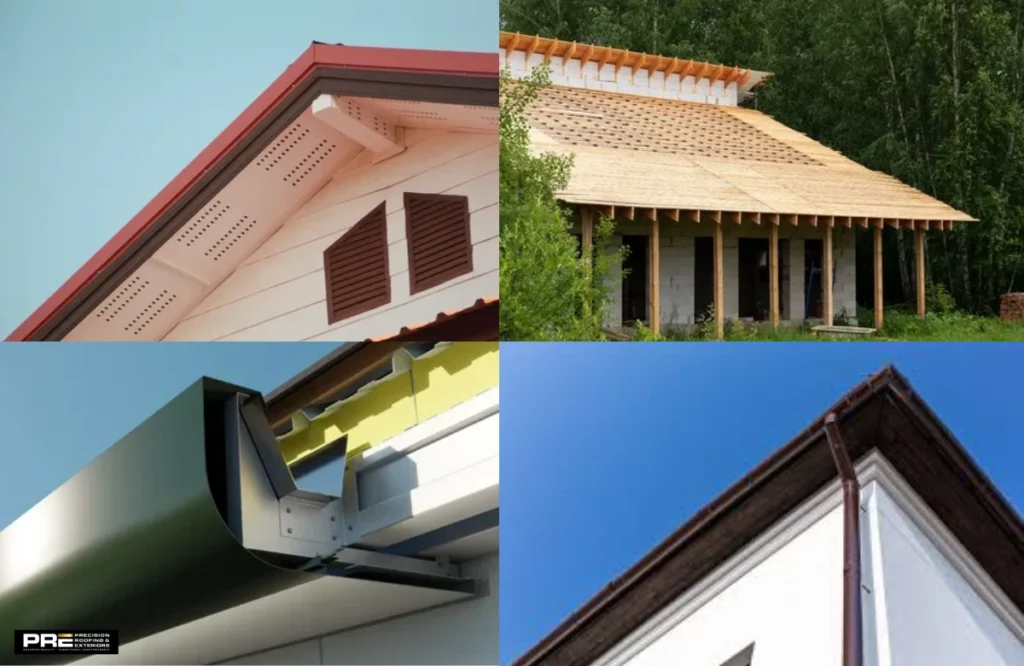
When you walk around the outside of your house and look up at the edge where the roof hangs over the walls, you are looking at the eaves. If you have ever wondered what roof eaves are, they basically act as the “umbrella” for your siding. They are the parts of the roof that extend past the exterior walls to keep rain from soaking your windows and foundation.
Without a decent overhang, every storm would send a sheet of water straight down your house, leading to rot and expensive repairs. To make them work, a pro has to measure the overhang, install the drip edge, secure the soffit, attach the fascia, and seal the joints.
Understanding Roof Eaves
Most people think the roof just stops at the wall, but that edge is a complex system. It isn’t just one board. It’s a mix of the fascia, which is the flat front board and the soffit, which is the flat part underneath. These pieces work together to keep water out and let your attic breathe.
If you don’t have enough of an overhang, your walls take a beating every time it pours. Experts always check these first when they look for water damage because if the eave fails, the rest of the roof usually follows pretty quickly.
Common Types of Roof Eaves
Not every house has the same style of overhang. Your home’s architecture usually dictates which of these four styles you have.
Closed Eaves
These are the most common ones you see in newer neighborhoods. The underside is completely finished with a soffit board, so you can’t see the rafters. It looks very clean and does a great job of keeping birds and squirrels from moving into your attic.
Open Eaves
You will find these on older craftsman homes or rustic cabins. In this style, the rafter tails are left exposed. It looks great and adds a lot of character but it means the wood is more exposed to the wind and rain. You have to keep a close eye on the paint to prevent rot.
Boxed-In Eaves
These are similar to closed eaves but have more of an architectural “box” look. They often include decorative molding where the roof meets the wall. It hides the structural parts while giving the house a more high-end, finished appearance.
Abbreviated Eaves
These are almost flat against the side of the house with very little overhang. You see them on modern, minimalist designs or old Cape Cod houses. Since there isn’t much of an umbrella effect here, the gutters have to be perfect to keep the walls from getting soaked.
Benefits of Roof Eaves
A solid overhang does more than just make your house look finished.
- Moisture Protection: They throw rainwater away from the walls, which saves your siding and window frames from rotting out.
- Temperature Control: In the peak of summer, wide eaves provide extra shade, which can actually help lower your cooling costs.
- Foundation Safety: By pushing water further away from the base of the house, they stop the soil from eroding or flooding your basement.
- Pest Prevention: Properly sealed eaves act as a barrier that keeps wasps and rodents from finding tiny gaps into your home.
Conclusion
At the end of the day, knowing what roof eaves are is key to understanding how your house handles the weather. These overhanging edges are the main reason your walls and foundation stay dry during a storm. Professionals know that to keep these areas healthy, you must measure the overhang, install a drip edge, secure the soffit, attach the fascia and seal the joints. If these parts are sagging or rotting, the whole house is at risk. Whether it’s a standard roof restoration or a full asphalt roof installation, the eaves are a top priority for any quality crew. Getting a shingle roof installation done right means paying attention to these small details. For any help with your roof, we Precision Roofing as trusted roofing contractors have you covered.
FAQs
What are the eaves in a roof?
They are the parts of the roof that hang out past the walls of the house. They create a protective border that keeps rain and snow away from your siding.
What is considered a roof eave?
Technically, anything that sticks out past the vertical wall is part of the eave. This includes the shingles on top, the fascia board on the front and the soffit underneath.
What are the 4 types of eaves?
The four main types are closed, open, boxed-in, and abbreviated eaves.