
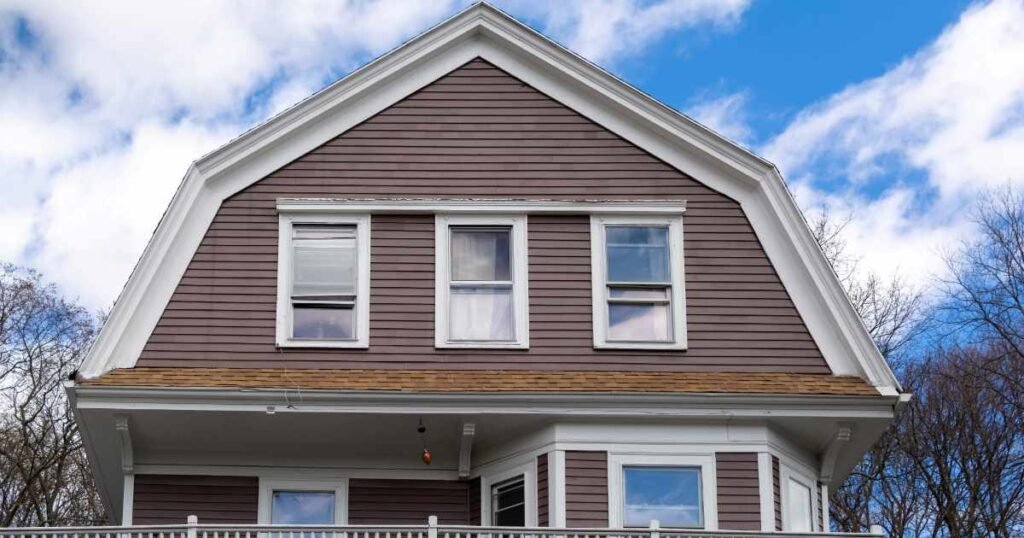
You’ve probably seen a barn or farmhouse with a roof that looks slightly folded. That shape is called a gambrel roof. It’s popular because it looks classic and makes smart use of space. This roof has two slopes on each side, which creates more room inside without changing the building’s overall height.
Its distinct shape balances symmetry with practical design. Homeowners value it for added attic room and cost efficiency. Installation involves careful planning, framing, and finishing. Common gambrel roof styles include symmetrical, dormered, and cross gambrels. Climate demands and maintenance needs are important considerations.
Brief Overview of a Gambrel Roof
A gambrel roof has slopes on both sides. The top is gently sloped, and the bottom end has a steep decline, which provides you with additional space on the inside. This ingenious design enables loft spaces to be real spaces rather than crawl spaces.
- The name comes from the Medieval Latin word “gamba”, referring to a horse’s hock or hind leg. If you look at the profile of the roof, it mimics that specific joint.
- This style came into popularity across North America in the 1600s and 1700s. Dutch settlers loved it because it allowed for a living space without the tax burden of a full second story (which was a real thing back then!)
- Today, you often see it on barns, Dutch Colonial homes, and farmhouse-style houses.
Key Characteristics and Designs of Gambrel Roofs
The gambrel roof’s shape and structure are what give it both style and function.
- Dual‑Slope Geometry and Structure
The two angles on each side let the roof shed water while pushing the sides outward for usable interior volume.
- Symmetrical Two‑Sided Design
Most gambrel roofs mirror themselves across a central ridge, giving buildings balance and clean lines.
- Enhanced Attic or Loft Space
The steeper lower angles create headroom that feels more like a room than an attic crawl space.
- Traditional Visual Appeal and Classic Aesthetic
There is an ancient, rustic quality to this profile, no matter how it is covered with metal or wood shingles.
- Trusses and Framing for Structural Support
Builders use trusses to tie the dual slopes together and support loads without needing a maze of internal beams.
- Overhangs and Eaves (in Some Designs)
Some versions extend beyond the walls to help protect siding and windows, and to add visual depth.
Advantages of a Gambrel Roof
Here’s the actual reason people choose a gambrel:
- A gambrel roof gives you more usable space inside because the steep lower slopes push the upper area outward. You can use this room for storage, a bedroom, or even a cozy studio without making the house taller.
- It is often cheaper to build than more complex roofs because the framing is straightforward and uses fewer materials.
- That classic barn-like shape adds character and curb appeal to homes, whether in rural or urban settings.
- The steep slopes also help shed rain and snow quickly, reducing leaks and water problems over time.
- Because there’s more attic volume, air can circulate better, which helps limit heat and moisture buildup.
Common Types of Gambrel Roofs
Here are some common gambrel roof styles you’ll see.
- Classic Symmetrical Gambrel Roof: The picture-perfect barn shape, with matching slopes on each side.
- Asymmetrical Gambrel Design: One side’s slopes can differ a bit, maybe to fit a porch or add visual interest.
- Gambrel With Dormers: Little window structures that pop out of the lower slope, bringing light and airflow inside.
- Cross-Gambrel Roof: Two gambrel roofs intersect, making a more complex interior space for wider homes.
- Wall-Supported or No-Overhang Gambrel: Here, the roof meets the walls tightly with minimal eave, great for clean lines.
- Mansard-Style Gambrel Roof: Gambrel meets mansard. The roof has double slopes on all four sides, giving a more enclosed but roomy profile.
Conclusion
A gambrel roof is not just a style. It is an ingenious construction decision when you desire to increase the use of space, create an equilibrium in visual character, and maintain the materials without piling up a second full story on top. Its ability to combine function with character makes this shape of roof attractive to people, whether you are attracted by its traditional shapes on Dutch Colonial residences or the space it offers to a loft or workshop. A gambrel roof can be both practical and impressive over the decades, with a good design and material added based on the weather conditions. You can contact Precision Roofing for expert advice and custom design options.
Frequently Asked Questions
What is the purpose of a gambrel roof?
It provides additional overhead space in a building, enabling the attic or upper floor to be used for storage or living space.
What is the difference between a gambrel and a mansard roof?
A gambrel has two slopes on just two sides with vertical gable ends. A mansard roof has two slopes on every four sides, similar to a French-style hip roof.
What are the disadvantages of a gambrel roof?
They need more maintenance and careful framing to avoid moisture and structural issues, and may be trickier in heavy wind or snow zones.